Hera spacecraft captures Didymos and Dimorphos as separate objects for the first time The European Space Agency 's Hera spacecraft has...
 |
| Hera spacecraft captures Didymos and Dimorphos as separate objects for the first time |
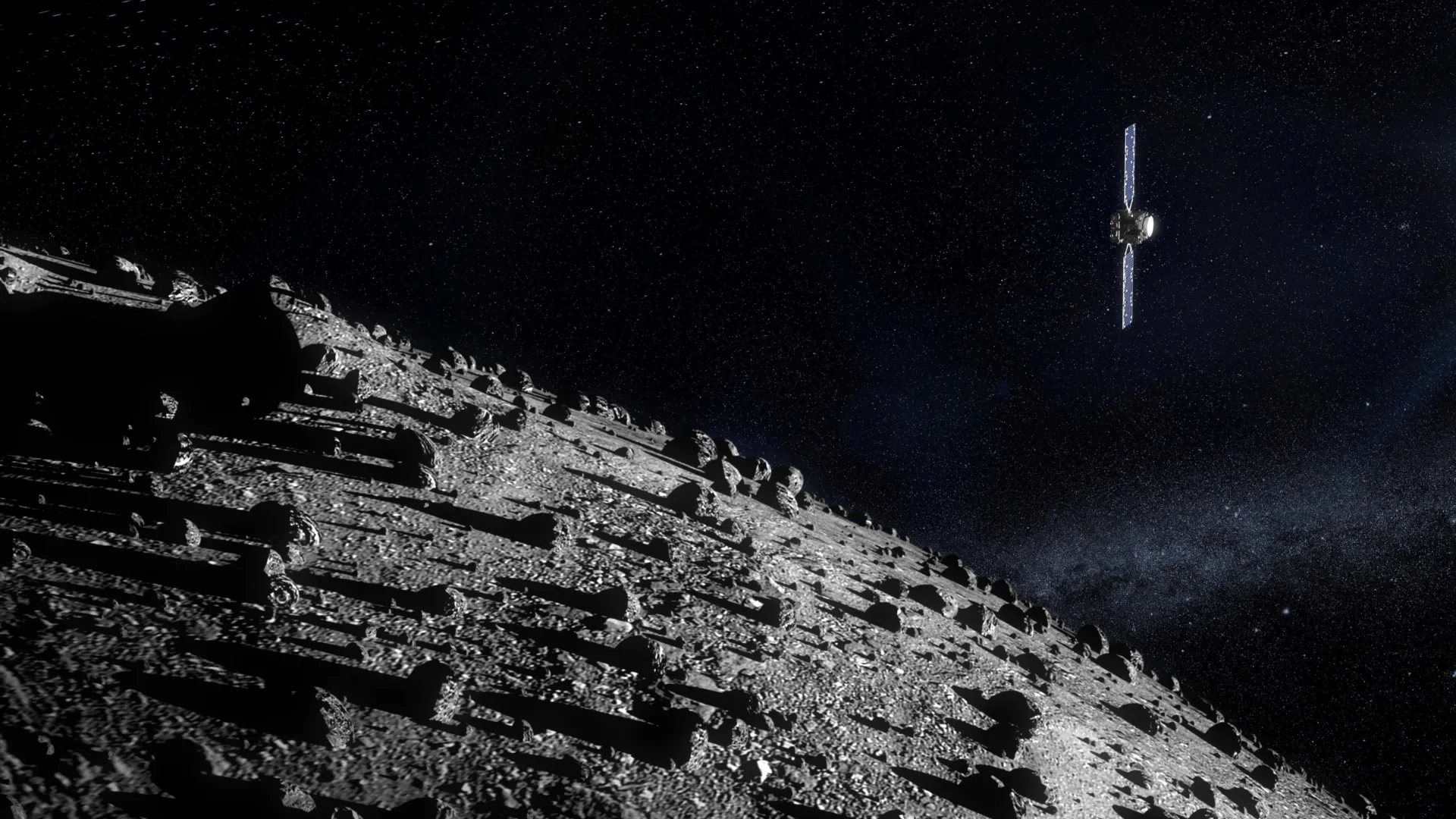
The European Space Agency's Hera spacecraft has reached an important milestone in its mission to investigate a historic asteroid collision. For the first time, its onboard camera has captured the two asteroids Didymos and Dimorphos as separate objects rather than a single point of light.
The asteroid pair is currently about 197 million kilometers from Earth. Hera obtained the new image on the evening of October 18 using its black-and-white Asteroid Framing Camera, while the spacecraft was approximately 1,280 kilometers from its targets.
"With this image, the smaller Dimorphos asteroid becomes visible for the first time," explains Michael Kueppers. "Before this acquisition, the spacecraft was still resolving the Didymos system as a single dot. But now, even though Dimorphos is made up of only around one pixel in this initial image, it is clearly well separated from its parent body."
Hera Closes In on Two Asteroids
The breakthrough image follows a successful series of maneuvers designed to slow Hera as it approaches the asteroid system. Earlier in October, the spacecraft fired its thrusters twice, with one week between the maneuvers. These adjustments reduced its speed relative to the asteroids to just 20 meters per second, allowing mission controllers to carefully manage the remaining approach.
Although the two asteroids appear tiny in the initial image, they are substantial objects. Dimorphos measures about 151 meters across, making it roughly comparable in size to the Great Pyramid of Giza. Its larger companion, Didymos, is approximately 780 meters in diameter, slightly smaller than the height of Dubai's Burj Khalifa, the world's tallest building.
Dimorphos travels around Didymos at an average separation of just 1.15 kilometers, moving at a speed of approximately 18 centimeters per second. "For the very first time we are seeing through Hera's own eyes the very double asteroid system that the mission was designed and built for," adds mission manager Ian Carnelli.
"Our views will grow much sharper as Hera comes closer. We will unveil the first detailed images of Dimorphos -- the first object in the Solar System to have had its orbit measurably shifted by human action -- on 25 November."
For the very first time we are seeing through Hera's own eyes the very double asteroid system that the mission was designed and built for,
Hera's arrival will give scientists an opportunity to examine the results of a groundbreaking planetary defense experiment conducted four years earlier. On September 26, 2022, NASA's Double Asteroid Redirection Test (DART) spacecraft deliberately collided with Dimorphos at approximately 6.1 kilometers per second. The impact blasted debris as far as 10,000 kilometers into space and shortened the asteroid's orbital period around Didymos by roughly 33 minutes.
The experiment demonstrated that a spacecraft could deliberately change an asteroid's motion, an achievement with potentially enormous implications for protecting Earth from future asteroid threats. However, the collision also produced results that scientists are still trying to fully explain. The asteroid's orbital change was substantially greater than computer simulations had predicted, raising questions about its physical properties and how it responded to the impact.
Researchers still do not know whether DART left a crater on Dimorphos or significantly altered the asteroid's overall shape. They also need more precise measurements of its composition, internal structure, and mass to understand why the collision was so effective.
Detailed Asteroid Investigation
Over the coming months, Hera will carry out a detailed 'crash site investigation' to uncover what NASA's collision actually did to Dimorphos. The spacecraft will use a collection of scientific instruments to examine the asteroid and its surroundings. It will also release two small satellites, known as 'CubeSats', each approximately the size of a shoebox, to gather additional observations from much closer distances. The investigation is expected to eventually include landing operations.
Together, these measurements should help scientists better understand how asteroids respond to high-speed impacts and improve predictions of how future deflection attempts might work.
Hera Space Companion
Anyone interested in following Hera's journey can explore the mission through the Hera Space Companion. More than a conventional AI chatbot, this interactive communication platform is connected to the mission and designed to make the European Space Agency's first planetary defense mission accessible to the public.